Solar Power for Truck Weighbridges in Nigeria: Load-Cell Power, Ticketing and Remote-Site Uptime
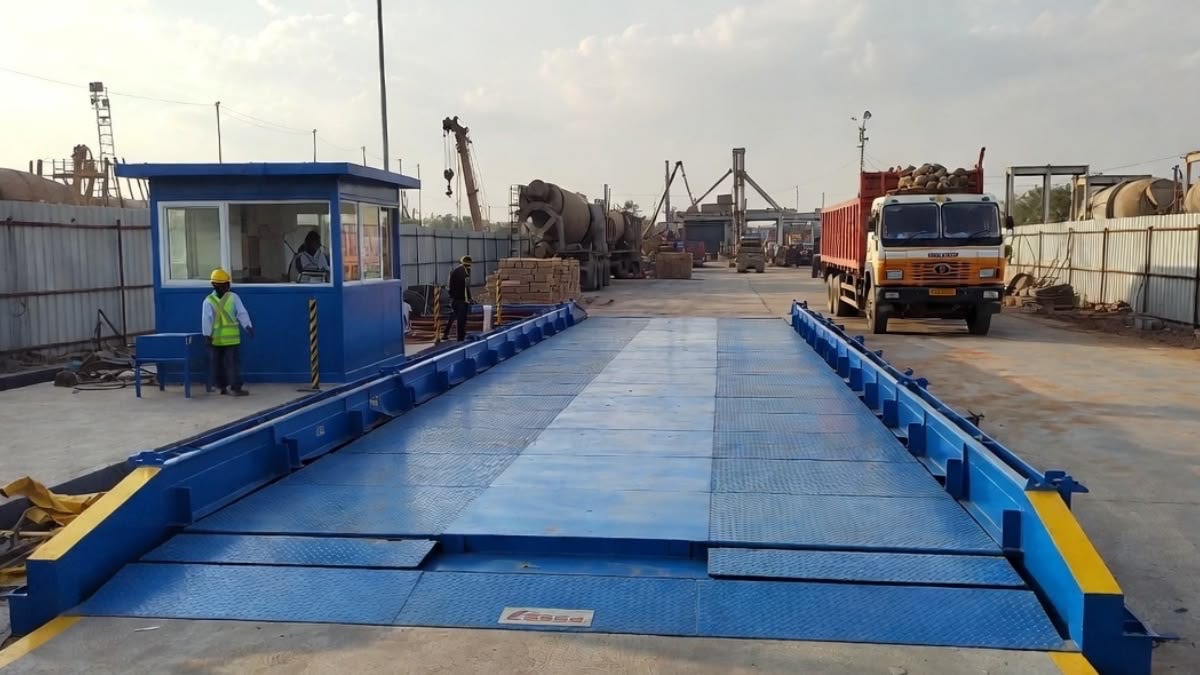
Truck weighbridges help logistics yards, quarries, agricultural depots, factories and bulk-material operators record vehicle weights for receiving, dispatch and commercial transactions. When the indicator, ticket printer, computer or communications equipment loses power, weighing may stop even if the heavy platform itself is mechanically sound.
A solar-and-battery supply can support a weighbridge kiosk or remote site, but the design must be built around the actual indicator, load-cell system, printer, network equipment, cameras, lighting and any gate barrier. The worked figures below are hypothetical planning examples—not a product specification, quotation, industry benchmark or completed Zookie Solar installation.
Why a weighbridge needs a different solar assessment
Unlike a production line, a weighbridge may use relatively little energy while still being operationally critical. The weighing electronics can be modest loads, while peripheral equipment—desktop computers, thermal printers, cameras, lighting, vehicle barriers and network devices—can change the demand profile.
The first question is not simply how many kilowatt-hours the site uses. It is which equipment must stay on, how long it must operate without grid power, what starts intermittently, and whether the system can preserve the records and communications the operator needs.
Separate the equipment into functional groups
1. Indicator and load-cell system
Confirm the indicator's input voltage, rated consumption, approved power supply and any manufacturer requirements for electrical noise or supply interruptions. Record the connected load-cell configuration and avoid modifying signal wiring or the weighing instrument as part of a solar installation without approval from the weighbridge supplier.
2. Ticketing and data capture
List the computer, monitor, ticket printer, database terminal, network switch and any software server used to record transactions. Printers draw power intermittently, so distinguish their active printing period from standby consumption.
3. Connectivity and monitoring
Include routers, modems, CCTV recorders and any remote-monitoring equipment that must remain online outside normal weighing hours. If the site uses cloud-based records, establish what happens when mobile or fixed internet service is unavailable.
4. Vehicle access and site services
A boom barrier, traffic light, access-control unit or number-plate camera may be separate from the weighing electronics. Barrier motors can have a short but significant starting demand, so their peak power must be checked even if their daily energy is small. Do not automatically place every yard floodlight or workshop machine on the same small backup system.
Illustrative daily energy schedule for a remote weighbridge kiosk
This hypothetical schedule demonstrates the calculation method for a small site. All power ratings and operating hours are assumptions. Replace them with the exact nameplates, manufacturer documentation and measured usage at the intended site.
| Load | Illustrative assumption | Daily energy |
|---|---|---|
| Indicator and load-cell excitation | 0.03 kW × 24 h | 0.72 kWh |
| Computer and monitor | 0.12 kW × 10 h | 1.20 kWh |
| Ticket printer | 0.08 kW × 1.5 equivalent h | 0.12 kWh |
| Router/modem | 0.015 kW × 24 h | 0.36 kWh |
| CCTV and recorder | 0.04 kW × 24 h | 0.96 kWh |
| Task lighting | 0.08 kW × 8 h | 0.64 kWh |
| Vehicle barrier motor | 0.40 kW × 0.1 equivalent h | 0.04 kWh |
| TOTAL | Sum of assumptions | 4.04 kWh/day |
The arithmetic is 0.72 + 1.20 + 0.12 + 0.36 + 0.96 + 0.64 + 0.04 = 4.04 kWh/day. This is not a recommended system size. A weighbridge with multiple cameras, a large printer, two kiosks, access-control equipment or extensive lighting could require more energy. A site without a computer or barrier could require less.
The assumed 30 W for the indicator and load-cell system is a placeholder for the combined connected equipment, not a universal specification. Confirm the actual input requirement with the weighbridge manufacturer.
A preliminary solar-array estimate
For a simplified energy estimate, assume 4.5 equivalent peak-sun-hours per day and a combined performance factor of 0.75. These are arithmetic assumptions only; they are not a solar-resource forecast for a specific location or season in Nigeria.
PV estimate = daily energy ÷ (peak-sun-hours × performance factor).
4.04 ÷ (4.5 × 0.75) ≈ 1.20 kWp.
Adding a provisional 25% planning allowance gives about 1.50 kWp. Treat this as an initial illustration, not a final array recommendation. A proper design must account for local and seasonal solar conditions, array placement, equipment losses, daytime load coincidence, battery recharge requirements and the possibility of several low-solar days.
If the weighbridge must operate around the clock, the array must supply daytime consumption and restore the energy used by the battery. The design cannot be finalised by dividing one day's energy by a sun-hours assumption alone.
Illustrative battery planning for overnight operation
Suppose the operator wants selected equipment to remain available for a 12-hour low-solar period. For this hypothetical example, the critical overnight loads are the indicator/load-cell system at 0.03 kW for 12 hours (0.36 kWh), router at 0.015 kW for 12 hours (0.18 kWh), CCTV/recorder at 0.04 kW for 12 hours (0.48 kWh), and task lighting at 0.08 kW for 4 hours (0.32 kWh). The total is 1.34 kWh AC.
Assuming 90% conversion efficiency and 80% usable nominal battery capacity, the energy-only estimate is 1.34 ÷ (0.90 × 0.80) ≈ 1.86 kWh nominal. Adding a provisional 25% reserve gives approximately 2.33 kWh nominal.
These are hypothetical energy calculations, not a battery recommendation. The selected battery must also meet the inverter's discharge-power requirements, the required autonomy, temperature and ageing allowances, manufacturer limits, and the time available to recharge. If the PC, printer or barrier must also operate during an outage, include them explicitly in the critical-load schedule.
Do not size the inverter from daily energy alone
Daily energy in kWh is not the same as peak power in kW or kVA. The inverter must handle the loads that operate simultaneously and any short-duration starting demand from motors such as a vehicle barrier. Confirm voltage, phase, power factor, surge duration and manufacturer requirements for every connected device.
For a small weighbridge kiosk, the barrier motor or a printer's peak demand may be more important to the inverter selection than its contribution to daily energy. Where the barrier can be supplied by a separate circuit or its own approved backup, assess that arrangement with the site operator and equipment supplier.
The power-conversion equipment should deliver the correct voltage and frequency for the connected devices. Use manufacturer-approved power supplies, suitable protection and a professionally designed source-transfer arrangement where grid or generator power is retained. Do not connect an inverter to existing wiring without verifying how the sources are isolated and controlled.
Solar power does not replace calibration or legal verification
A stable power supply can reduce avoidable interruptions, but it does not prove that a weighbridge is accurate. Measurement performance also depends on the platform and foundation, load cells, junction boxes, indicator configuration, installation condition, maintenance and the instrument's calibration or verification status.
Nigeria's Federal Ministry of Industry, Trade and Investment states that its Weights and Measures Department oversees legal metrology and the accuracy, fairness and legality of measurements used in trade. Its published mandate includes testing, verification and certification of weighing and measuring instruments used in commercial and industrial settings.
The Standards Organisation of Nigeria explains that calibration may be required for a new instrument, after repair or modification, after relocation, at specified intervals, or when readings appear questionable or an instrument has experienced shock or damage. Follow the applicable legal-metrology requirements and the weighbridge manufacturer's instructions; confirm any required verification with the appropriate authority.
Keep the solar installation separate from the metrology approval process. Have the weighbridge supplier or qualified service technician review any change that could affect the indicator, load-cell wiring or measurement system. After a power-related fault or equipment modification, do not assume that restoring electricity alone confirms the instrument is fit for trade.
What current Nigerian market signals show
A Nigerian retailer currently lists a 10–120-tonne weighbridge and describes 220 V AC or optional solar power for remote sites, alongside a digital display with backup battery. This is a vendor listing, not an independent test of the product's solar performance.
A separate Nigerian truck-scale supplier advertises load cells, a digital indicator, ticket printing and remote monitoring for industrial weighing installations. These commercial pages show that power options and connected equipment are being marketed in this segment; they do not establish the size of the market, verified system performance or reliable Google search volumes.
Searches of accessible public community results did not surface a sufficiently strong, recent discussion specifically about solar-powered truck weighbridges to support a claim of broad community consensus. The market signal here is the availability of vendor-offered solar options, not an invented social trend.
Prepare this information before requesting a solar proposal
- Make, model, supply voltage and input power for the indicator, load-cell system, printer, computer, monitor and network equipment.
- The operating schedule: hours of active weighing, overnight monitoring and expected number of transactions.
- Whether the site has a vehicle barrier, traffic lights, ANPR camera, CCTV, floodlights or other equipment that must be backed up.
- Measured energy consumption, where available, and the peak loads that can operate simultaneously.
- Required autonomy, acceptable interruption duration and whether grid or generator power will remain available.
- How tickets and weighing records are stored during internet or power interruptions.
- The weighbridge manufacturer's requirements and the applicable calibration or legal-verification schedule.
- The intended locations for panels, inverter, battery and kiosk equipment, plus site access and environmental constraints.
Ask for a written design that identifies the PV capacity, inverter output and surge capability, battery nominal and usable energy, backup duration assumptions, protected circuits, source-transfer arrangement, monitoring, commissioning checks, maintenance plan and exclusions. Require the proposal to be checked against the actual weighbridge equipment—not a generic solar package.
Design for accurate records and dependable weighing operations
A solar-powered weighbridge should be planned as a small, mission-critical electrical system. Start with the actual equipment, separate continuous electronics from intermittent peripherals, verify peak demand and define exactly what must stay online during an outage.
Zookie Solar Ltd provides solar-system design, equipment supply, installation and technical consultation for Nigerian businesses. Request a site-specific assessment for your weighbridge kiosk, ticketing equipment, communications and required backup duration.
Zookie Solar Ltd — Built on Power. Driven by Excellence.
Email: admin@zookiesolar.com