Solar Power for Block-Making Businesses in Nigeria: Vibrating Machines, Mixers and Production Loads
Solar Power for Block-Making Businesses in Nigeria
Learn how to plan solar power for Nigerian block-making businesses, including vibrating machines, concrete mixers, motor starting, daily energy use and battery requirements.
Solar Power for Block-Making Businesses in Nigeria: Vibrating Machines, Mixers and Production Loads
A block-making yard depends on more than sunlight and an inverter. Electric vibrating machines, mixers, conveyors and control systems can have very different power demands, and motor starting can be much harder on a solar inverter than steady lighting or office equipment. A solar design that ignores the production cycle may power the yard’s lights but fail when the main machine starts.
This guide explains how Nigerian block manufacturers can assess machine loads, estimate daily energy, plan solar generation and decide which production processes should run on solar. It is a planning guide; the final design must use actual equipment nameplates, measured operating data and the machine manufacturer’s instructions.
Why Block-Making Equipment Needs a Different Solar Assessment
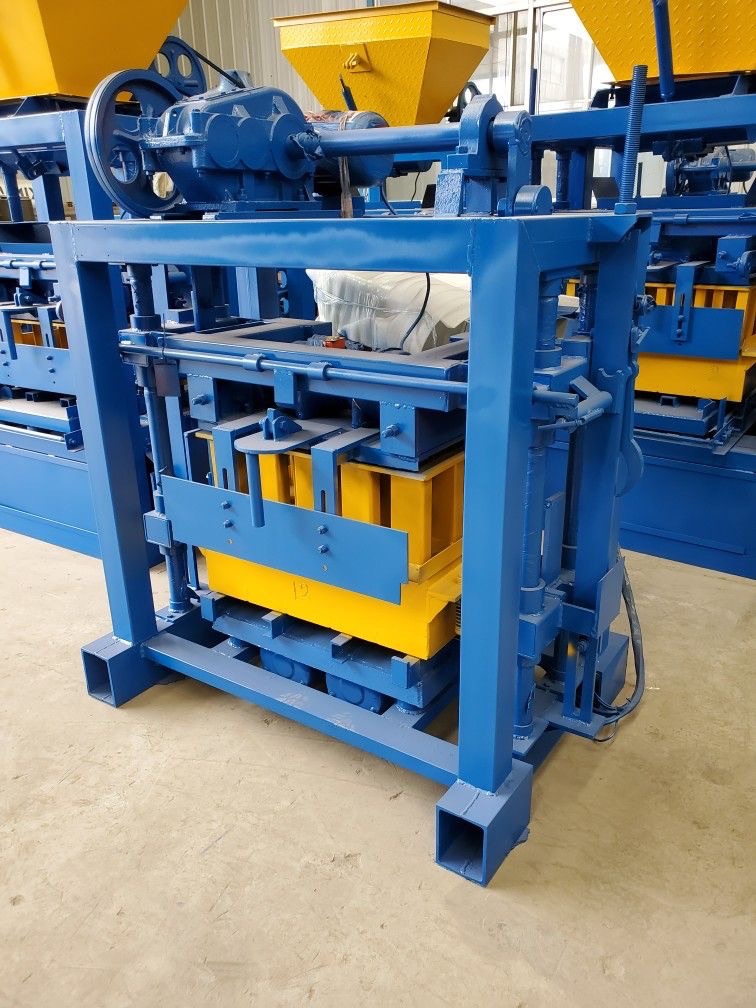
Block yards may use a manual press with a small vibrator, a semi-automatic hydraulic machine, or a larger production line with a mixer and conveyors. These are not interchangeable loads. A small machine may have a single-phase vibration motor, while a larger machine may require three-phase power and several motors operating in a coordinated cycle.
Current Nigerian equipment listings illustrate that specifications vary. A recent Jiji listing for an ST4 block-making machine in Epe displays a 3.8 kW machine-power figure and mentions a 5 HP electric vibrator. Other marketplace listings show different ratings. These are seller-provided details, not verified specifications for every machine, so confirm the nameplate and manual before designing the electrical supply.
A block-machine supplier’s power-planning guide published on 2 October 2026 also distinguishes manual, semi-automatic and fully automatic equipment, with very different reported power requirements. Treat supplier guidance as an initial reference—not a substitute for the exact machine datasheet and a site load survey.
Step 1: Map the Production Process
List the equipment that will actually be powered electrically. Depending on the yard, this may include:
- The block press or moulding machine and its vibration motor.
- A concrete or pan mixer.
- Aggregate-feeding equipment or conveyors, if installed.
- Hydraulic power packs and machine controls.
- Compressors or other auxiliaries, where part of the production line.
- Task lighting, security and essential office equipment.
Do not assume every machine on site must run from one solar system. Define whether the project is intended to supply auxiliary loads, one production machine, the mixer as well, or the entire production line. That boundary changes the required inverter power, solar capacity and storage budget.
Step 2: Verify the Real Electrical Requirements
Record the rated power, voltage, phase, full-load current, frequency, power factor and starting method from each motor nameplate. Ask the equipment supplier for the wiring diagram, starting-current information and any restrictions on inverter or variable-frequency-drive operation.
Where production is already running, a qualified technician can measure actual input power and current during a normal cycle. Include the mixer, vibration, hydraulic operation and any auxiliary equipment that may operate at the same time.
Do not size the inverter from the kW figure alone. The design must consider continuous output, apparent power in kVA, motor starting current, simultaneous starts, phase requirements and the inverter manufacturer’s motor-load limits. A three-phase machine cannot be assumed to operate correctly from an ordinary single-phase inverter.
Step 3: Estimate Energy from Actual Operating Hours
For each load, estimate energy using its measured or verified input power and the time it actually runs—not automatically the full length of the work shift.
Daily energy (kWh) = input power (kW) × equivalent running hours per day
Vibrators may run only during parts of a production cycle. Mixers may operate in batches. Use realistic equivalent running hours and refine them with meter readings once the yard is operating.
Illustrative Calculation: A Small Block Yard in Abeokuta
This is a hypothetical example for explaining the arithmetic. It is not a surveyed customer site, a final system design or a completed Zookie Solar project. The assumed equipment ratings and hours must be replaced with actual nameplate and measured values.
Load
Assumed input
Equivalent operating time
Energy/day
Block machine vibrator
2.2 kW
4 hours
8.8 kWh
Mixer
3.0 kW
3 hours
9.0 kWh
Controls and auxiliaries
0.5 kW
4 hours
2.0 kWh
LED task/security lighting
0.2 kW
8 hours
1.6 kWh
**Illustrative total**
**21.4 kWh/day**
The assumed running loads total 5.9 kW if all four categories operate simultaneously. That figure is only the combined running-power estimate; it does not capture motor-starting surges or prove that a particular inverter can run the equipment.
If the actual machine is rated at 3.8 kW rather than 2.2 kW, recalculate daily energy and peak demand. Online advertisements can help identify questions to ask, but the machine’s own verified data must govern the design.
Step 4: Estimate a Preliminary Solar Array
For an arithmetic illustration, assume the example yard uses 21.4 kWh per day, receives five equivalent peak-sun-hours and has a combined performance factor of 0.75. These are assumptions, not a site-specific solar forecast.
Adding a provisional 20% allowance gives approximately 6.85 kWp as an energy-based starting point for discussion—not a final array recommendation. The actual array may need to be larger to cover production while charging storage, recover after cloudy periods, accommodate seasonal variation and stay within inverter PV-input limits.
The array calculation does not determine whether the inverter can start the machine. PV energy and motor-starting capability are separate design questions. Both must be checked.
Step 5: Decide What the Battery Must Do
A battery should have a defined job. For some block yards, it may be intended to keep controls, lighting, communications and small auxiliary loads operating through short interruptions. In other designs, the operator may want the battery to support production motors as well. Those are very different requirements.
If the battery is expected to run the block machine or mixer, the designer must verify both energy capacity in kWh and power capability in kW, including starting current and the duration of each production cycle. A battery with enough stored energy can still be unable to deliver the required instantaneous power.
Do not assume a battery sized for lights and office equipment can run a high-starting-current motor. Nor should a battery-only design be approved simply because its nominal kWh total appears adequate. Test the intended operating sequence against the inverter and battery manufacturers’ limits.
Step 6: Manage Motor Starts and Production Timing
The production sequence can affect peak demand. Where the machine manufacturer permits it, avoid starting several large motors at exactly the same time. Record the start-up sequence and assess whether approved soft-start or variable-speed equipment is suitable for the specific motor and controller.
Do not add a soft starter or variable-frequency drive without checking compatibility with the machine controls and the manufacturer’s instructions. These devices can change starting behaviour, but they are not universal fixes for an undersized inverter.
Schedule energy-intensive production during the solar window when practical, while keeping the actual production and curing process within the quality requirements for the blocks. Do not sacrifice product quality or machine safety to fit a solar schedule.
Step 7: Design for Dust, Vibration and Outdoor Conditions
Block yards are dusty and often exposed to rain, cement residue and mechanical vibration. The inverter, battery and control equipment should be installed in a suitable, ventilated and protected location. Enclosures and installation details must match environmental conditions and equipment manufacturer requirements.
Keep cement dust away from ventilation openings and heat sinks, and make sure routine inspection and safe isolation are possible. A qualified electrical professional should determine the correct protective devices, earthing, isolation and wiring arrangement for the actual installation.
Step 8: Measure Energy per Production Output
After commissioning, track energy consumption alongside production output. One useful benchmark is kWh per 1,000 blocks, calculated over a clearly defined production period.
Energy per 1,000 blocks = measured production energy ÷ blocks produced × 1,000
For example, if the illustrative 21.4 kWh were used to produce exactly 1,000 blocks, the result would be 21.4 kWh per 1,000 blocks. This is a worked arithmetic example, not a benchmark for the Nigerian block-making industry. Compare like-for-like batches and record machine settings, block type, output and operating hours.
This measure can help an owner notice changes in machine performance or production routines. It should not be used alone to judge block quality, because material mix, curing, moisture and machine settings also matter.
Common Solar Planning Mistakes at Block Yards
Choosing a system from the advertised machine capacity without checking the nameplate.
Confusing kW, kVA and daily energy in kWh.
Ignoring motor-starting demand or assuming all motors start independently.
Sizing a battery by kWh alone without checking power delivery and surge limits.
Assuming a small single-phase inverter can operate a three-phase machine.
Using daily energy calculations as proof that an inverter can start the production equipment.
Failing to separate essential auxiliary loads from the loads required for full production.
Accepting a vendor’s advertised production rate or power claim without verifying the machine and testing it under real operating conditions.
Information to Prepare Before Requesting a Solar Quote
The exact machine model, manufacturer datasheet, nameplate photographs and phase requirements.
The mixer, vibrator, hydraulic unit, conveyor and auxiliary equipment list.
Measured running power and starting current where available.
The expected production shift, actual machine duty cycle and target blocks per day.
Which machines must run simultaneously and which may be sequenced.
Whether the battery is intended for auxiliary loads only or for production motors too.
Site conditions, dust exposure, available installation area and plans for production expansion.
Ask the installer to state the design assumptions clearly: expected daily kWh, maximum simultaneous running load, motor-starting capability, required phase, battery role, solar recovery assumptions and the commissioning tests to be performed.
Plan Your Block Yard’s Solar Power with Zookie Solar
The right solar solution for a block-making business starts with the production process and the machine data—not a generic inverter package. A properly scoped assessment can establish which loads should be included, when they operate and what the system must be able to start and sustain.
Zookie Solar Ltd provides solar design, installation, maintenance and energy solutions for businesses. Contact admin@zookiesolar.com to discuss a solar assessment for your block-making yard or concrete-products operation.
Zookie Solar Ltd — Built on Power. Driven by Excellence.
Solar Power for Barbershops and Hair Salons in Nigeria: Clippers, Dryers and Peak-Load Planning