Solar Power for Commercial Laundries in Nigeria: Washing Machines, Dryers and Daily Load Planning
Solar Power for Laundries in Nigeria: Washer & Dryer Sizing
Learn how to size solar for Nigerian commercial laundries using washing-machine energy, dryer technology, inverter capacity, battery backup and daily operating loads.
Solar Power for Commercial Laundries in Nigeria: Washing Machines, Dryers and Daily Load Planning
A commercial laundry can lose revenue when a wash cycle is delayed, clothes remain damp while customers wait, or equipment cannot complete its scheduled work. For operators serving households, students, salons, short-let apartments and businesses, dependable electricity affects turnaround time and customer confidence.
Solar can support a laundry business, but a proper design must distinguish washing energy from drying energy, machine start-up demand and the loads that genuinely need battery backup. Two laundries with the same number of machines may require different systems if one uses heat-pump dryers and the other uses high-power electric resistance dryers.
Why Solar for Laundry Businesses Is a Relevant Nigerian Topic
Nigerian web results include retail bundles pairing washing machines with solar power stations, showing that consumers are actively being offered laundry-and-solar combinations. In April 2026, Peoples Daily reported that LG Electronics had commissioned a solar-powered mobile laundry service in Osusu-Amankwa, Aba. PriVida Power also announced a February 2026 programme aimed at supplying productive-use solar systems to Nigerian micro, small and medium-sized enterprises. These are useful market signals, but they do not establish measured Google keyword volume or prove that every laundry can run on a small system.
Public Nigerian community discussions have long raised practical questions about laundry-business electricity, generator capacity and operating profit. A Nairaland thread about coping with erratic power in laundry services dates to 2013, and another business thread asked what generator capacity would support a washing machine and pressing equipment in 2016. Their age means they should be treated as evidence of a recurring operational concern, not as a measure of current search volume.
A separate Reddit discussion posted in September 2026 by someone planning a laundry business asked about electricity costs for several washers and dryers and proposed a solar setup. It is outside Nigeria, so it is not Nigerian market evidence, but it illustrates a recurring design mistake: estimating a system from battery amp-hours and rough wattage without first calculating cycle energy and simultaneous demand.
Step 1: Audit the Laundry Workflow Before Choosing Equipment
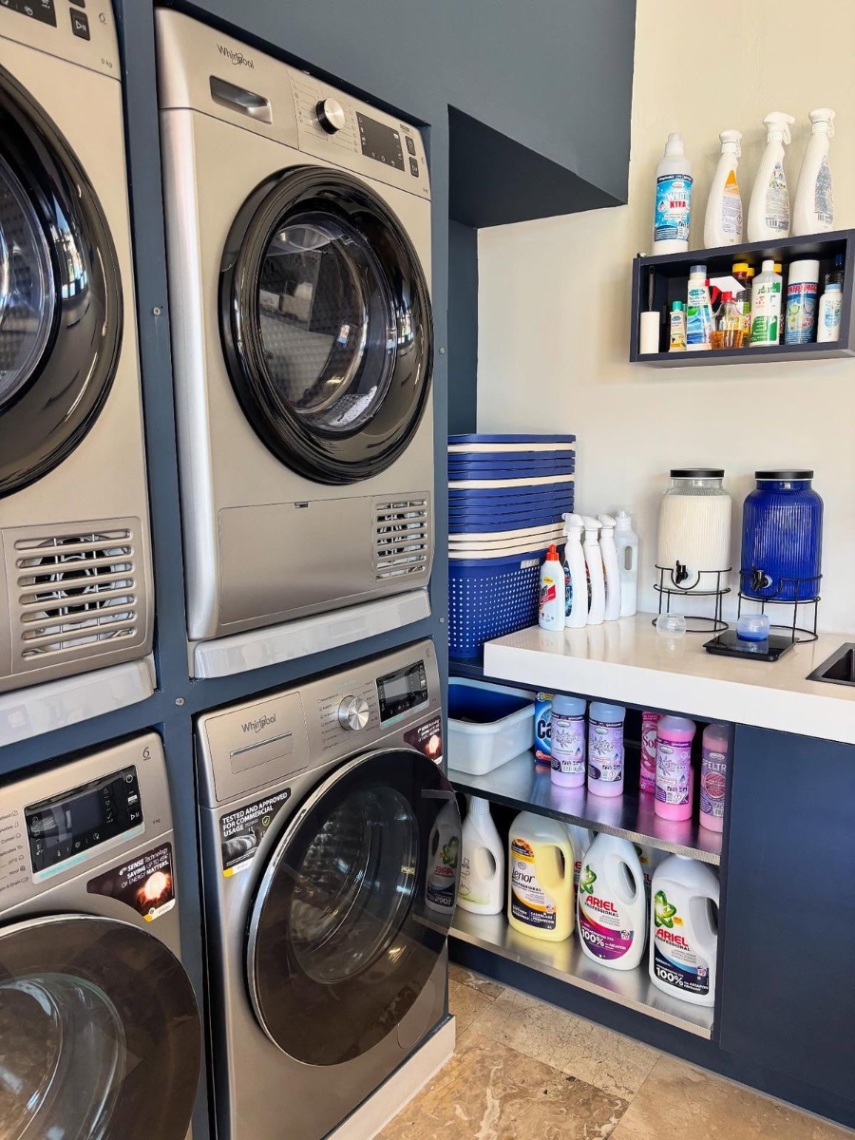
Build an inventory of the actual machines and operating schedule. Photograph each nameplate and record voltage, phase, rated input, cycle time and manufacturer. Separate the following loads:
Washing machines: note the model, load capacity, heating function, spin cycle and rated input.
Tumble dryers: identify whether they use heat-pump, electric-resistance or gas heating. A gas dryer still has electrical loads for controls, drum drive and fans.
Steam presses or irons: record the rated wattage and the hours they are actually heated, rather than assuming they run continuously.
Water-supply and drainage equipment: include electrically powered transfer pumps or treatment equipment, based on nameplate data and measured duty cycle.
Shop support loads: lighting, fans, POS terminal, router, CCTV, computer and customer-area equipment.
Do not size a solar system from the machine count alone. A machine’s maximum input is useful for inverter sizing, while energy per cycle is more useful for estimating daily consumption. Those figures are related but are not interchangeable.
Step 2: Pay Special Attention to Drying
Drying can be the decisive electrical load in a laundry. A commercial heat-pump dryer listed by an authorised equipment distributor has a rated input of 2.3 kW and a stated full-load energy use of 1.28 kWh over a 42-minute cycle. By contrast, a commercial vented electric dryer may be offered with 6 kW or 8 kW heating options. The exact model and its nameplate must determine the design.
Where operationally appropriate, a heat-pump dryer may reduce electrical energy per load compared with a conventional resistance-heated dryer. A gas dryer may also reduce electrical heating demand, but the site must separately meet the appliance’s fuel, ventilation, exhaust and safety requirements. Do not assume that all dryers are compatible with the same inverter package.
Step 3: Calculate Daily Energy and Peak Demand Separately
Daily energy is calculated as:
Energy (kWh) = Power (kW) × Operating time (hours)
For cycle-based appliances, use the manufacturer’s energy-per-cycle figure when it is available and relevant to the selected programme. If the manual does not provide it, measure the machine over representative loads or clearly label an estimate as an assumption.
Peak demand is different. It asks which machines may run at the same time, including heaters and motor start-up. A laundry can have a moderate daily energy requirement but still need a substantial inverter if several machines overlap.
Illustrative Example: A Small Commercial Laundry in Jos
This is a hypothetical calculation, not a surveyed site, final engineering design or completed Zookie Solar project. The figures below are assumptions for planning practice. Replace them with the selected equipment’s actual specifications and measured cycle data.
Equipment / load
Assumption
Daily use
Estimated energy
Three washing machines
0.80 kWh per wash cycle each
4 cycles each
9.60 kWh/day
Two heat-pump dryers
1.28 kWh per full load each
4 cycles each
10.24 kWh/day
Lighting, fans, POS and network
0.50 kW combined
8 hours
4.00 kWh/day
Steam-press station
1.50 kW average while heated
2 hours
3.00 kWh/day
**Illustrative total**
—
—
**26.84 kWh/day**
The washing-machine cycle figure of 0.80 kWh is an illustrative assumption, not a manufacturer claim. The dryer figure is based on the cited specification for one particular 7.5 kg heat-pump model. Actual consumption varies with equipment, fabric moisture, load size, selected programme and operating conditions.
This example suggests a working-day energy requirement of about 26.8 kWh before additional design allowances. If the business operates more cycles, uses high-power electric dryers or adds water-heating equipment, the energy estimate can rise substantially.
Step 4: Estimate a Preliminary Solar-Array Size
For a first-pass estimate, divide daily energy by equivalent peak-sun-hours and an overall performance factor that allows for system losses. For illustration, assume 4.5 peak-sun-hours and a performance factor of 0.75. These are planning assumptions, not a forecast for a specific Nigerian site.
26.84 kWh ÷ (4.5 × 0.75) ≈ 7.95 kWp
Adding a provisional 20% planning margin gives about 9.5 kWp. An array in the region of 9.5–10 kWp could be investigated for this illustrative daily-energy profile. This is not a final recommendation: the designer must verify the local solar resource, seasonal operating pattern, actual cycle energy, PV-input limits, available mounting area and the energy required to recharge the battery after outages.
Step 5: Check the Inverter Against the Actual Simultaneous Loads
Suppose the three washers have a nameplate input of 1.8 kW each, two heat-pump dryers are rated at 2.3 kW each, the press station is 1.5 kW and shop support loads total 0.5 kW. A simplified simultaneous-load sum is:
(3 × 1.8) + (2 × 2.3) + 1.5 + 0.5 = 12.0 kW
The 1.8 kW washer figure is an assumption for this example and must be checked against each actual nameplate. The 12 kW sum is not automatically the correct inverter size. Confirm continuous real-power output, power factor, motor-starting current, heater cycling, phase requirements and manufacturer limits. If all equipment does not need to run together, a documented operating sequence may reduce required simultaneous capacity—but the business must be able to follow that sequence.
Do not compare proposals by kVA alone. Ask for continuous kW output, surge capability, phase configuration and a written list of which machines can operate together.
Step 6: Size the Battery for a Defined Backup Task
A battery should be sized around a stated service objective, not an undefined promise to keep the whole laundry running through every outage. The business may choose to reserve battery power for one washer, one heat-pump dryer and essential support loads, while scheduling other cycles for strong solar hours.
For an illustrative single wash-and-dry sequence, assume 0.80 kWh for washing, 1.28 kWh for one dryer load and 0.40 kWh for shop support during the job. The combined AC energy is 2.48 kWh. If the preliminary design assumes 80% usable battery capacity and 90% inverter efficiency:
A nominal battery around 4–5 kWh could be investigated for that limited energy task, subject to battery discharge limits, reserve, warranty, temperature and the actual equipment data. It must also be capable of supplying the required instantaneous power. A battery with enough stored energy may still be unsuitable if its discharge-power limit is too low.
If the target is several hours of operation, multiple simultaneous cycles or electric-resistance drying, recalculate the battery requirement from the full critical-load schedule. Do not treat this one-cycle example as a whole-shop backup design.
Step 7: Plan How the Laundry Will Operate on Solar
Schedule energy-intensive wash and dry cycles during the hours when solar generation is strongest, where delivery commitments allow.
Avoid starting every dryer and press at the same time until the inverter’s operating limits have been verified.
Track cycles per day, energy per kilogram of laundry and rejected or delayed jobs; these are useful operational indicators.
Keep lint filters, air paths and machine maintenance up to date according to manufacturer instructions, because poor airflow and maintenance can affect cycle performance.
Reassess the system before adding another washer, dryer, electric water heater or steam press.
Scheduling can improve how the system is used, but it cannot compensate for an undersized array, inverter or battery when the business genuinely requires simultaneous operation.
What a Solar Quotation for a Laundry Business Should Include
Request a written design that states:
The equipment inventory, nameplate ratings and assumed cycles per day.
Estimated kWh per cycle and total daily energy, with assumptions identified.
Maximum simultaneous kW demand, motor-starting and heater considerations.
PV array rating and inverter PV-input limits.
Inverter continuous kW, kVA, surge capability and phase configuration.
Battery nominal and usable energy, discharge-power rating and the exact backup task it is intended to support.
Expected recharge conditions, monitoring, protective equipment, commissioning tests and warranties.
Any excluded loads, including electric water heating or high-power resistance dryers.
Comparing quotations is only meaningful when each installer has been given the same machine list, operating hours, production target and backup requirement. A low headline price can hide a system that was never designed to operate the machines the owner expects to use.
Plan a Laundry-Focused Solar System with Zookie Solar
A commercial laundry needs a design based on wash-cycle energy, drying technology, peak simultaneous demand and the jobs that must continue during an outage. A system designed for lighting and small appliances is not automatically suitable for multiple washers and dryers.
Zookie Solar Ltd provides solar system design, installation, maintenance and energy solutions. Before requesting an assessment, prepare photographs of machine nameplates, equipment manuals, daily cycle counts, operating hours and a record of which machines normally run together. That information helps turn a rough estimate into a practical engineering proposal.
Zookie Solar Ltd — Built on Power. Driven by Excellence.
Contact **admin@zookiesolar.com** to discuss a production-focused assessment and a quotation based on your actual equipment.
How to Match a Lithium Battery to a Solar Inverter in Nigeria: BMS, Voltage, CAN & RS485 Guide