Solar Power for Pure Water Factories in Nigeria: Treatment Pumps, RO Systems and Sachet Packaging Loads
Solar for Pure Water Factories in Nigeria | Load & Battery Guide
Learn how to size solar for Nigerian pure-water factories, including RO treatment, pumps, sachet packaging machines, inverter capacity and battery backup.
Solar Power for Pure Water Factories in Nigeria: Treatment Pumps, RO Systems and Sachet Packaging Loads
For a sachet-water or bottled-water producer, electricity is part of the production line. When power fails, treatment may stop, filling and sealing can be interrupted, and staff may have to restart processes or postpone deliveries. A solar system can improve operating continuity, but a water factory must be assessed as a connected process—not as a building with a few appliances.
The key is to understand when raw-water transfer, filtration, reverse osmosis (RO), disinfection, filling, sealing, coding and packing operate together. Those processes do not all draw the same amount of power, and not every machine needs to run throughout the shift.
Why solar for water production is gaining attention in Nigeria
In a public LinkedIn post viewed in October 2026, Nigerian water-treatment company GITO Solutions described its planned Trickle drinking-water plant in Ikorodu, Lagos. The post said the concept was designed around production of 16,000 bottles of 750 ml and 17,600 sachets of 500 ml a day, with approximately 250 kWp of solar PV and LiFePO₄ battery storage. The post described a plant being built, not a completed or independently verified operating result. It is a useful current signal that energy planning is becoming part of the packaged-water production conversation.
Current Nigerian equipment listings also show why the exact production line matters. One sachet packaging machine listing specifies approximately 1.6 kW for a machine that combines filling, sealing and cutting. A listed bottled-water line, by contrast, includes equipment such as a PET bottle blower and high-pressure compressor, shrink-wrapping equipment and a steam tunnel, with much higher individual power ratings. These are seller-published specifications and should be checked against the exact equipment supplied.
The practical lesson is simple: do not size a water factory from the packaging machine alone, and do not copy a large plant's solar capacity for a smaller operation. Build the design from the real process, machine nameplates, measured demand and production schedule.
Step 1: Map the whole production process
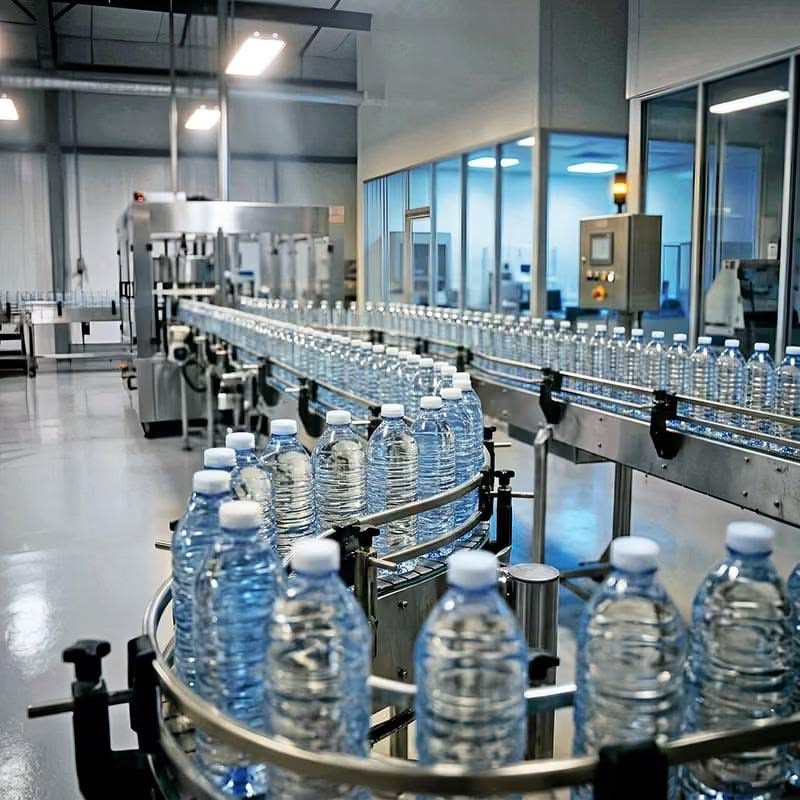
Before choosing an inverter, solar array or battery, draw the sequence of operations and list every electrical item. A typical sachet-water line may include a raw-water transfer pump, filtration equipment, a treatment or RO feed pump, a high-pressure RO pump where RO is used, UV disinfection and controls, a treated-water tank, a sachet filling and sealing machine, date coding, task lighting, fans and office equipment.
A bottled-water operation may add bottle blowing, compressed-air equipment, rinsing/filling/capping monoblocks, labelling, shrink wrapping, conveyors and steam or electric heating equipment. Those additions can change the plant's power profile dramatically. Treat each machine as a separate load until its actual operating sequence is understood.
Step 2: Record nameplate ratings and measure real operation
Record the voltage, phase, rated current, power rating, motor type and manufacturer for each machine. Note which loads operate continuously, which run in batches, and which are interlocked. For motors and compressors, record starting behaviour as well as running power. Where safe and practical, use a qualified technician and suitable power analyser to log real power, current and start-up events during a representative production shift.
Do not assume that a machine's advertised production rate tells you its electrical demand. Nor should a seller's specification replace the nameplate and commissioning checks on the delivered unit. Models and configurations can differ, particularly when pumps, heaters, compressors or additional accessories are supplied separately.
Step 3: Separate daily energy from simultaneous demand
Daily energy helps estimate the solar-array and storage requirements. Simultaneous demand helps determine inverter capacity. They are related, but they answer different questions.
Use this formula for each load: Energy (kWh) = Power (kW) × operating time (hours). Add the energy for all loads that operate during the production day. For inverter sizing, add the loads that may genuinely operate at the same time, then account for power factor, motor starting, overload duration and any three-phase requirements.
Illustrative example: a small sachet-water plant
The following example is hypothetical and intended to show a calculation method only. It is not a surveyed site, a final design, or a completed Zookie Solar installation. All pump ratings and operating hours below are assumptions; the actual plant may differ.
Equipment or load
Assumed running power
Assumed daily use
Estimated daily energy
Raw-water transfer pump
0.75 kW
3 hours
2.25 kWh
Treatment/RO feed pump
1.10 kW
5 hours
5.50 kWh
RO high-pressure pump
1.50 kW
5 hours
7.50 kWh
Sachet filling/sealing machine
1.60 kW
6 hours
9.60 kWh
UV, controls and small instruments
0.12 kW
8 hours
0.96 kWh
Production-area lighting
0.20 kW
10 hours
2.00 kWh
Fans and ventilation
0.30 kW
8 hours
2.40 kWh
Office computer and printer
0.20 kW
4 hours
0.80 kWh
**Illustrative total**
—
—
**31.01 kWh/day**
This hypothetical plant uses about 31 kWh over a production day under the stated assumptions. The packaging-machine value is consistent with the order of magnitude of some seller-listed sachet machines, but the assumed pump ratings, operating hours and other loads are illustrative only. The actual daily energy may be substantially different.
The table also does not mean all equipment runs together for the full shift. The pumps may run during treatment cycles while packaging operates later or in parallel. The production schedule must be documented before the designer decides how much solar energy is consumed directly and how much must be stored.
Step 4: Make a preliminary solar-array estimate
For an early energy estimate, divide daily energy by the expected equivalent peak-sun-hours and a performance factor to allow for conversion and system losses. The example below uses planning assumptions, not a guarantee of daily production.
Adding a provisional 20% planning margin gives about 11.0 kWp. An array in the region of 11 kWp could therefore be investigated for this illustrative daily energy profile, provided a site-specific study confirms the solar resource, actual load profile, array layout, inverter input limits and required battery-recharge window.
This estimate is not a promise that an 11 kWp array will run every machine in every weather condition. If production runs longer, the pumps use more power, the site has a higher-energy RO system, or the factory needs to recover battery charge quickly after an outage, the array may need to be larger. The final design should use local conditions and logged energy data.
Step 5: Check the inverter against the loads that run together
For a simplified peak check, suppose the raw-water pump, feed pump, high-pressure pump, sachet machine, UV and controls, lighting, fans and office equipment could all be on together. Adding the assumed running powers gives approximately 5.77 kW. This is a preliminary running-load sum, not a final inverter selection.
The designer must check the starting current of pumps and any compressor, the power factor of each motor, the inverter's continuous real-power rating, short-duration surge capacity, and whether any machine needs three-phase power. A 5.77 kW running sum does not automatically mean a 6 kW inverter is sufficient. A suitable design may require a higher continuous output, sequencing controls or a different motor-starting arrangement.
Do not connect a three-phase production machine to a single-phase system merely because its average power appears manageable. Confirm each machine's voltage and phase requirements and design the distribution and protection accordingly.
Step 6: Decide which processes need battery backup
Battery capacity should be based on the specific process that must continue during an outage, not on the factory's total connected load by default. Some plants can schedule water treatment and storage-tank filling when solar generation is strong, then use the stored treated water to support a later packaging run. That approach is only suitable when the tank, sanitation procedures, treatment controls and water-quality plan are designed for it.
For example, suppose a defined critical group averages 1.8 kW and must run for three hours. Its AC energy requirement is 1.8 kW × 3 hours = 5.4 kWh. If the preliminary assumptions are 80% usable battery capacity and 90% inverter efficiency, the nominal battery estimate is 5.4 ÷ (0.80 × 0.90) = 7.5 kWh. A nominal battery around 10 kWh might be evaluated as a starting point for that defined load, subject to the manufacturer's usable-energy limits, discharge current, temperature, warranty and required reserve.
That battery example does not cover every pump and machine in the table. If the plant wants RO pumping and packaging to continue together through the same outage, the required storage could be much larger. Batteries also need enough charging power and time to recover before the next production shift.
Step 7: Schedule production around the energy system
A solar-first production plan can reduce the amount of energy that must pass through batteries, but scheduling must follow water-quality and production requirements. Consider these operating practices:
Run energy-intensive treatment cycles during strong solar hours where the treatment process and water-quality controls permit.
Coordinate treatment and packaging schedules to avoid unnecessary simultaneous peaks.
Use treated-water storage only where tank capacity, sanitation and quality procedures support it.
Avoid starting multiple motors and compressors at once unless the system has been designed for that event.
Track energy per production shift and compare it with output volume.
Reassess the design before adding a new pump, RO stage, bottle blower, compressor or shrink tunnel.
A timetable must never bypass treatment steps, disinfection, required holding times or product-quality checks. Solar is a power source; it does not replace the factory's hygiene controls, testing or applicable regulatory obligations.
Sachet-water plants and bottled-water lines need different designs
A small sachet-water plant may mainly use pumps, treatment equipment and a filling/sealing machine. A PET bottled-water line can add bottle blowing, high-pressure compressed air, heating, shrink wrapping and other production machinery. Supplier-published examples show that some bottle-line components are rated in the tens of kilowatts, while a sachet packaging machine may be listed around 1.6 kW. The full line—not the headline machine—must be assessed.
If a factory is planning to expand from sachets into bottles, do not simply add a few panels to the existing system. Rebuild the load schedule, check inverter and phase capacity, estimate the new production energy, and determine whether the current battery and protection equipment can support the new line.
What a useful solar quotation should include
Ask the installer for a machine-by-machine load schedule; measured or manufacturer-supported operating power; expected simultaneous demand; solar-array capacity and string design; inverter kW, kVA, surge and phase specifications; battery nominal and usable capacity; expected autonomy and recharge time; protection and isolation equipment; monitoring; commissioning tests; warranty details; and a clear list of which machines are included or excluded.
Ask for the proposed operating assumptions in writing. A quotation that promises the whole factory will run continuously should explain what happens when all pumps start, the battery reaches its reserve limit, or production extends beyond the planned shift. Compare quotations using the same production schedule and machine list.
Commission the plant under real operating conditions
Before accepting the installation, test the solar system with the agreed sequence of treatment, pumping and packaging loads. Record inverter loading, start-up events, battery state of charge, alarms, output voltage and the ability to recharge after the test. Confirm that protective devices operate correctly and that staff understand which combinations of equipment are permitted.
Keep the single-line diagram, equipment schedule, commissioning report, manuals and warranty documents accessible. Train operators to report unusual motor noise, repeated alarms or unexplained production interruptions. Qualified personnel should perform electrical installation, protection checks and commissioning.
Plan your water factory's solar system with Zookie Solar
A reliable solar solution for a sachet-water or bottled-water factory begins with the complete process: treatment, pumping, disinfection, filling, sealing, coding and packing. The right design must reflect actual machine ratings, production hours, simultaneous demand and the amount of backup the business genuinely needs.
Zookie Solar Ltd provides solar system design, installation, maintenance and energy solutions. If you operate a pure-water factory or are planning a new production line, prepare your machine list, nameplate photographs, production schedule and recent grid or generator records before requesting a site assessment.
Zookie Solar Ltd — Built on Power. Driven by Excellence.
Contact Zookie Solar at admin@zookiesolar.com to discuss a production-focused assessment and a quotation based on your factory's actual loads.
How to Match a Lithium Battery to a Solar Inverter in Nigeria: BMS, Voltage, CAN & RS485 Guide