"How much is solar?" is one of the first questions almost every Nigerian homeowner or business asks before making the switch. The honest answer is that there is no single price for a solar system. A small backup system for lights, fans, a TV and a router is completely different from a system designed to run air conditioners, freezers, pumps and other heavy loads.
In 2026, publicly available Nigerian market guides show a wide spread in solar-system pricing. That spread is not necessarily a sign that someone is overcharging: battery size, inverter quality, panel capacity, installation complexity, equipment brand and the customer's required backup time can change the final price dramatically. This guide gives you a realistic framework for understanding the cost of solar in Nigeria in 2026, without pretending that one price fits every home or business.
1. A Quick 2026 Solar Price Guide
As a broad market reference, recent Nigerian 2026 guides place complete installed systems across very different price bands. One published guide lists approximately ₦850,000–₦1.2 million for entry-level 1–2kVA systems, while another places 3–5kVA systems around ₦1.8 million–₦4 million. A separate 2026 guide puts 3–5kVA complete systems around ₦2.95 million–₦5.54 million and 8–10kVA systems from roughly ₦5.8 million upward. These differences demonstrate why the exact equipment list matters more than a headline package price.
For a practical budgeting conversation, you can think in broad categories rather than one fixed number:
- Basic/entry backup: roughly ₦800,000–₦1.6 million
- Mid-sized residential systems: roughly ₦1.8 million–₦5.5 million
- Larger homes and small businesses: roughly ₦5 million–₦10 million+
- Higher-demand commercial systems: can run well beyond ₦10 million
These are indicative market ranges, not Zookie Solar quotations. Equipment brands, battery capacity, exchange-rate movement, installation requirements and location can move a quote significantly.
2. What Actually Makes Up the Cost?
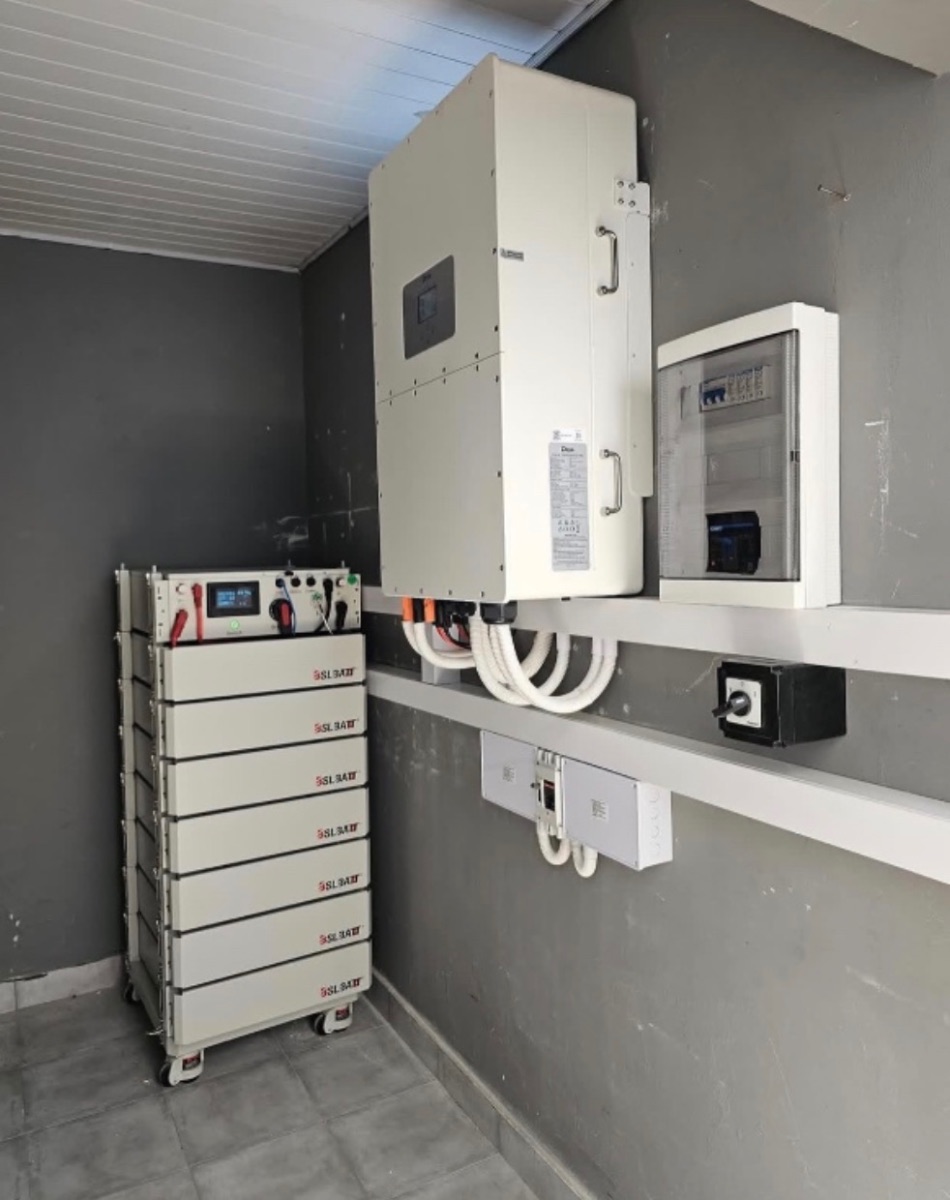
A complete solar installation is normally made up of several major cost areas:
- Solar inverter
- Solar panels
- Battery storage
- Mounting structures
- DC and AC cables
- Breakers, isolators and surge protection
- Earthing and electrical protection
- Installation labour
- Transportation and logistics
- System configuration, testing and commissioning
The battery and inverter can represent a particularly large share of the total cost, especially when a customer wants substantial night-time backup. A recent Nigerian 2026 market guide, for example, lists a 3.5kVA hybrid + 5kWh lithium + 8×450W panel package at about ₦3.4 million and a 5kVA hybrid + 10kWh lithium + 16×450W package at about ₦5.54 million.
3. Solar Panels: What Should You Budget?
Panel pricing depends heavily on wattage, technology, brand and availability. A 2026 Nigerian market guide lists indicative ranges such as ₦115,000–₦145,000 for 550W panels and ₦155,000–₦200,000 for 650W panels, while branded 550W examples can fall around ₦125,000–₦160,000 depending on the brand and specification.
But panel price alone does not tell you whether a panel is suitable for your system. The installer also needs to check the inverter's maximum PV voltage, current and permitted PV power, then design the panel string configuration correctly.
4. The Inverter Is More Than a kVA Number
Inverter prices vary according to capacity, technology, brand, battery compatibility, solar-input capability, warranty and features. A small inverter may be adequate for essential loads, while a larger hybrid inverter may be needed for multiple air conditioners, pumps, freezers or other heavy appliances.
One June 2026 Nigerian pricing guide lists a 1.5kVA hybrid inverter from around ₦259,000, while complete inverter-and-battery systems and full solar-and-lithium packages move into the millions.
Do not compare two inverters solely by price. Compare their continuous output, surge capability, battery voltage, MPPT/PV specifications, efficiency, protection features, warranty and battery compatibility. Our brand comparison tool lays several of these side by side if you want a shortcut.
5. Batteries Can Change the Entire Budget
If your goal is simply to power appliances while solar is available, you may not need the same battery capacity as someone who wants the home powered throughout the night. Battery capacity is measured in kWh and determines how much stored energy is available. A 5kWh battery and a 15kWh battery can be connected to similar inverter architectures, but they provide very different levels of stored energy.
Lithium batteries generally cost more upfront than many lead-acid alternatives, but they can offer advantages in usable capacity, cycle life, maintenance and system performance when correctly specified. A recent 2026 Nigerian market article gives a 5kWh battery example around ₦1.5 million within one system-cost model, illustrating how significant battery storage can be in a complete-system budget.
6. Why Two Solar Quotes Can Be ₦2 Million Apart
Suppose two installers quote you for a "5kVA solar system." That description alone does not make the systems equivalent.
Installer A might be quoting a smaller battery, fewer panels, lower-cost equipment and basic installation. Installer B might be quoting a larger lithium battery, more PV capacity, premium inverter, better protection, stronger mounting, longer warranty and more extensive installation work. Both may honestly call their systems "5kVA." Yet they can have completely different capabilities and expected runtimes. The right question is not "Who is cheaper?" It is "What exactly am I getting for the money?"
7. A Solar System Should Be Sized From Your Load
The correct process starts with your appliances and usage pattern. A customer who needs lights, fans, TV, router and refrigerator backup has a different requirement from a customer who wants two air conditioners, a freezer, a water pump and kitchen appliances.
The installer should establish:
- Which appliances you want to power
- Their approximate power consumption
- Which appliances operate simultaneously
- How many hours they run each day
- Whether the loads are mainly daytime or night-time
- How many hours of backup you expect
- Whether you want to add appliances later
Only after that should the inverter, battery and solar array be selected. If you would rather skip the back-and-forth, our free energy audit walks through exactly this list with you.
8. Why Night-Time Usage Can Make Solar More Expensive
This is one of the most important points customers overlook. Solar panels generate most of their useful energy during daylight. If your biggest loads operate after sunset, that energy needs to come from your battery or another power source.
For example, someone who comes home around 7pm and wants air conditioning, refrigeration, lighting, television and other appliances until morning may need considerably more battery storage than someone who uses the same appliances mainly during the day. The more night-time energy you want, the more important battery capacity becomes, and battery capacity can significantly increase the total project cost.
9. Installation Is Part of the System
A solar system is not simply equipment delivered to your house. Professional installation can involve panel mounting, cable routing, DC and AC protection, changeover arrangements, earthing, surge protection, battery installation, inverter configuration, testing and commissioning.
Roof type, cable distance, number of floors, panel location and site accessibility can all affect labour and installation materials. A quote that looks cheaper because installation and protection have been left out may become more expensive once all the missing work is added.
10. Beware of the "Too Good to Be True" Solar Package
A very cheap solar quote should make you ask questions, not immediately celebrate. Check:
- Exact inverter model and capacity
- Exact battery model, voltage and kWh
- Number and wattage of panels
- Whether panels are new and genuine
- Cable sizes
- Protection equipment
- Mounting materials
- Installation scope
- Warranty terms
- Transport and other hidden charges
The cheapest quote is only cheaper if the systems being compared are genuinely equivalent.
11. Lithium vs Lead-Acid: Why Battery Choice Matters
Lead-acid batteries can reduce the initial purchase price in some applications, but they generally require different operating practices and may offer less usable energy and shorter cycle life than a well-designed lithium system.
Lithium iron phosphate (LiFePO₄) batteries have become popular for modern solar installations because of their high usable capacity, long cycle life and lower routine maintenance requirements. That does not mean lithium is automatically the best choice for every customer. The right battery depends on budget, required runtime, load profile, installation environment, compatibility and long-term goals.
12. Does a Bigger Solar System Always Mean Better Value?
Not necessarily. If your actual essential load is small, buying a huge inverter and oversized battery can tie up money that could be used elsewhere. On the other hand, buying a system that is too small can lead to frustration, frequent low-battery events and additional upgrade costs.
The best-value system is the one that comfortably handles your priority loads, provides the backup duration you actually need and leaves sensible room for your future plans.
13. How to Compare Solar Quotes Like a Professional
When you receive three quotations, create a simple comparison table with these columns:
- Inverter brand/model
- Inverter capacity
- Battery brand/model
- Battery voltage
- Battery capacity in kWh
- Panel brand/model
- Panel wattage
- Number of panels
- Total PV capacity
- Protection equipment
- Mounting structure
- Installation scope
- Warranty
- Transport/logistics
- Total price
This immediately reveals whether you are comparing three similar systems or three completely different packages.
14. What Should Be Included in a Good Solar Quotation?
A professional quotation should make the equipment and scope clear. At minimum, you should be able to identify the inverter, batteries, panels, cables, protection equipment, mounting materials, labour/installation and any other major accessories. It should also state the applicable warranty terms and what is excluded.
If a quotation simply says "5kVA solar system — ₦X" without a detailed equipment list, you do not have enough information to make a reliable comparison.
15. Is Solar Worth the Cost in Nigeria in 2026?
For many households and businesses, the value of solar is not only about replacing electricity from the grid. It can also be about reducing generator use, improving power availability, protecting business operations and making energy costs more predictable.
Whether a particular system is financially worthwhile depends on how much you currently spend on electricity and fuel, how often power is unavailable, what loads you need to support and how much of the solar energy you can actually use. A professional assessment should therefore consider both the equipment cost and the customer's energy pattern.
16. Frequently Asked Questions
How much does a basic solar system cost in Nigeria in 2026?
A basic system can start around the high hundreds of thousands of naira, but a more realistic installed budget depends heavily on the battery and equipment included. Recent 2026 Nigerian market guides show entry systems ranging from roughly ₦800,000 to ₦1.6 million.
How much is a 5kVA solar system in Nigeria?
There is no single price. Recent 2026 market examples put complete 3–5kVA systems anywhere from roughly ₦1.8 million to above ₦5 million depending on equipment and battery capacity.
How much does a 5kWh lithium battery cost?
Prices vary substantially by brand and specification. It is better to compare the exact battery model, usable capacity, warranty and cycle specifications rather than a generic "5kWh battery" price.
Why is lithium solar more expensive?
The battery can represent a large part of the total project cost. Lithium systems can offer longer cycle life and higher usable capacity, but the upfront investment is usually higher than many lead-acid options.
Can I install solar gradually?
Yes. A properly planned system can sometimes be designed for staged expansion, but the inverter, battery architecture, PV limits and wiring should be selected with the future expansion plan in mind.
17. The Zookie Solar Approach
At Zookie Solar, we believe a solar system should be designed around your actual energy needs, not around a generic package that looks attractive on a flyer.
We look at your appliances, usage pattern, desired backup time and future plans before recommending the appropriate inverter, battery and solar capacity. That approach may sometimes mean a smaller system than you expected. In other cases, it may reveal that you need a larger battery or more solar panels than a basic package provides. The objective is simple: build a system that performs the way you expect it to perform.
Conclusion
There is no single "solar price in Nigeria" for 2026. You can find entry-level systems in the hundreds of thousands of naira, while properly equipped residential and commercial systems can cost several millions, and high-demand systems can go much higher. Recent Nigerian market guides confirm just how wide the range can be.
The most important thing is not to chase the cheapest quotation. Compare the actual inverter, battery, panel capacity, protection, installation scope, warranties and expected performance. Before spending millions of naira on solar, get your load properly assessed and make sure you understand exactly what the quotation includes.
Need a solar system designed around your home or business? Contact Zookie Solar for a professional assessment and tailored quotation.